Unibox

1797421_10152436642313258_2965283131295847025_nThe first French album to really make an impression this year, is the untitled debut by Unibox. Not the most convenient bandname, if you ask me. Google it, you’ll see. Unibox is a six-piece, three girls (Valerie, Alice, Adeline) and three guys (Loic, Theophile, Baptiste). As I understand it, Valentine is one singing the most tracks. The music has touches of early Air (Fille de l’air, Intro), classic chanson (Suis Moi) and restrained Moodoïd (i.e. less psychedelic). The voices, the duets, the gentile atmosphere, it’s breezy, upbeat (even if most lyrics aren’t) and, in case of album closer Cette Nuit, just brilliant. Listen to the full album on Spotify.

Je m’appelle Charlie

Four singers, La Grande Sophie, Jeanne Cherhal, Camille and Emily Loizeau, expressed their feelings about the slaying at the Charlie Hebdo offices in a song. Read the lyrics in this Figaro piece.

Marie-Pierre Arthur

Welcome in the 10th year of FillesSourires.com. Here’s a new track by Marie-Pierre Arthur. Guestposter Mark Sullivan has the news:

Et voilà – Marie-Pierre Arthur is Filles Sourires’ first new song of 2015.
‘Rien à faire’ is the advance track of her third album, ‘Si l’aurore’ (does the title remind you of anything?) due out on 17 February. It catches the ear straight away – and seems a definite move by MPA from folk-rock into pop. The beginning has a late 80s feel: it recalls for me the start of ‘Love Power’, the Dionne Warwick – Jeffrey Osborne number by Burt Bacharach and Carole Bayer Sager. And it’s a potential dance track. It puts Marie-Pierre into yacht rock/AOR territory, Taylor Swift territory even. And it’s better than Swift’s own move from country & western into pure pop.
This augurs well / cela est de bon augure pour l’album.

La Féline

20141217 La Feline ArtworkSo I’d already drafted my album of the year when I recalled a post concerning Agnès Gayraud’s project La Féline. The EP in question, “Adieu l’enfance”, had recently morphed into a full-blown album, so I gave it a metaphorical spin… And the more I listened the more there was this nagging voice in the back of my head that kept telling me that this was a truly gr-r-eat album…

“Adieu l’enfance” is the most intoxicating mix of eighties-influenced dreamy electronic synth-pop, guitar-tinged indie-pop all mixed with spell-binding vocals; “Les fashionistes (au loin)”, outwardly a wry observation on the ‘sameness’ of the fashion police but actually that of the world viewed from the perception of the alienated outsider. The song’s hypnotic beat and Agnès’ breathless vocal style create a compelling soundtrack of a disturbingly dystopian landscape…


“La ligne d’horizon” features the most dreamy synth pop rhythms – complete with a haunting trumpet refrain with a touch of cello that add extra depth and poignancy to the coda; The album’s title track kicks-off with looped-vocals and the most gorgeous of synth-pop rhythms. The vocals are breathless – spellbinding – the chorus is uplifting – a song that does not so much regret the passing of a childhood moment as rejoice; “Zone”, with the must exhilarating – pounding – industrial synth soundtrack, that about half-way through seamlessly transformed into an indie-rock song.

Guitar-fuelled indie rock gets an airing with “Midnight”, a song that wouldn’t have sounded out of place on The Cure’s “Seventeen Seconds”; the beguiling a cappella “Rêve de Verre”, a resplendent multi-dubbed choir and a hymn to the loss of innocence and “La fumée dans le ciel” complete with gorgeous vibrato guitar that transports you back to the sixties (‘retromania’ as Agnès might say?)

The overall effect of this album is to create a succession of timeless song which expertly blended the familiar with the yet to be discovered. Indeed, the whole raison d’être of the album is captured by “Moderne”; melancholic and thoughtful, a manifesto to the belief that ‘new’ is in fact ‘old’ and newness is just a reinvention of the past. (Agnès touches upon the idea of ‘modern is old’ in the pages of her fascinating blog “Moderne, c’est déjà vieux” (“Modern it’s Already Old”).

“Adieu l’enfance” is, upon reflection, too good an album to pass up…

Best of 2014 (Part 7)

MusiqueFrancoWhat actually constitutes a “French” song? I thought about this while perusing an article in the French-Canadian blog L’Animateur Culturel! which – correctly – defines a French song as one that is performed in the language of Molière and not – as it is often incorrectly described – a style.

For me – a Francophone Englishman and someone who passionately believes that a great song actually transcends language – a great French song is actually a great song that just happens to be performed in French. Conversely, I’m not just going to love a song just because the artist happens to be performing the song in French… There has to be a certain “je ne sais quoi” in the first place to whet the appetite.

And because I’ve already decided that it’s a great song, whatever the particular genre (be it pop, alt-rock, indie, folk, etc… depending on what is rocking my particular boat) it is always going to stand comparison against any song, irrespective of language…

“La musique en français c’est n’est pas un style de musique. Y’a de tout en français!” (“Music in French is not a style of music. They are all in French!”)

So when it came to selecting a song of the year – which in many respects is actually far easier than choosing an album (you’re looking at one moment of sheer brilliance as opposed to a degree of consistency over a number of tracks) – I was looking for that one moment that not only perfectly encapsulates the artist, but also would stand shoulder to shoulder with any other song in a similar category that was released this year…

201412xx Filles Sourires ArtworkI’d actually got a short-list of three(!), but ultimately – and having long bemoaned the dearth of innovative French (or french-Canadian) indie-rock artists – there can be only one song of the year.

Hôtel Morphée’s “Dernier jour” is a dark and deliciously subversive thumping alt-rock tune; all pounding drums and repetitive bass overlaid with Laurence Newbornne’s gorgeous rasping, sultry vocals… And then the refrain kicks in, the vocals soar, imploring, there’s a ferocity – at times animalistic edginess here… All of a sudden those trademark syncopated rhythms of orchestral strings are centre-stage. The song literally explodes between the ears… and then it’s gone… replaced by silence… the heart is still pounding…

Best of the Best (part 6): Nevche

Regular guestposter Adrian Arratoon goes back to his fave track of the year, by Nevche. And looks forward!

Vas-tu freiner? by Nevche was my track of the year, from their Retroviseur album. A haunting, nocturnal, poetic track that was utterly beguiling. The bit where the slightly discordant riti, or Senegalese violin, comes for the first time in was probably the moment of the year in French music for me. The rest of the album is pretty much essential listening too.

2015 already looks bright, listen to the first single of a new album (released next year) by Dominique A:

Best of the Best (part 5): Mina Tindle

Regular guestposter Mark Sullivan picks an exceptional track by Mina Tindle
ob_ae9bc9_mina-tindle-dsc03275
Mina Tindle’s new album ‘Parades’ hides within it a dance track which must be among the best of 2014 in any language. At Mina’s one appearance in Britain, in London in November, ‘The Curse’ was unknown to most of us the audience until it suddenly began, rather different from her classic style. We stood mesmerized by this unnamed tour de force, with its great instrumental middle part. When Mina (Pauline de Lassus) signed my CD afterwards, I asked her what this extraordinary track was, and she wrote the name for me.

‘The Curse’ is about the idea of rebuilding a relationship (‘Let’s go back to where it felt right’) but then deciding not to (‘And you won’t be around, It won’t hurt so bad’), with the title taken from one line, ‘Magic or curse, I don’t regret’. As a dance track, it deserves a wide audience.

‘The Curse’ is the key song in Mina Tindle’s elegant ‘Green Lagoon’ filmed session, preceded by ‘Pas les saisons’, the much-admired ‘I command’, and ‘Ā Seville’. (Four of the tracks on ‘Parades’ are in English, eight in French.)
‘The Curse’ starts with a run-in at 15m55s. Or watch the song by itself here. Steffen Charron, her bass guitarist, who plays in the film, told me that they were amazed at the perfect location, a restored sand quarry turned nature park just 60 km south of Paris.

A well-filmed performance by Mina of ‘The Curse’ at this July’s FNAC Paris concert is here. It starts at 3m25s after ‘Pas les saisons’. The full set at Paris (40 minutes) is also on YouTube. She does 8 songs: Bells; Ā Seville; Lovely day; Madonne; Too many small things; I command (at 21m35s); Pas les saisons; The Curse (30m56s to 36m00s)

For the background to ‘Parades’ see Mina’s website page. ‘Le Figaro’ now calls her ‘la plus anglophone des chanteuses françaises’.
As if to prove it, here she is singing Bruce Springsteen’s ‘I’m on fire’ in Paris last month

Two interviews in English from 2012 (here) and 2014 (here) tell us more about Mina’s background and career. And she is in person charm itself.

Best of 2014 (Part 4): Stéphanie Lapointe

20141112 Stephanie Lapointe ArtworkIt is safe to say that 2014 has produced a bumper crop of Francophone albums. Many of these have appeared in this very blog and some have even been reviewed by yours truly. Mentally I’m whittling a year’s worth of albums to a top 10… And then Guuz announces that this year we’re going to only nominate one album… just one… our choice for the album of 2014…

So… I’ve thought long and hard about my choice and so with apologies to Hôtel Morphée, Chloé Lacasse, Catherine Leduc and Salomé Leclerc, to name but a few of my top 10 – all of whom are arguably responsible for some of the great albums of this (or any) year. Somehow though I already knew the other nine albums on my list were going to be (very, very) good and I was already anticipating their release. Hopefully someone will nominate them (if not you’ll be able to read about them again elsewhere), but my album of the year has to be the one that not only was I totally unprepared for, but also – and to quote Guuz himself – left me more than a little bit shaken in the process…

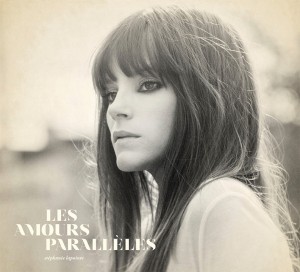
Montréalaise singer-actress-author and Unicef ambassador Stéphanie Lapointe released her last album back in 2009. This year she released “Les amours parallèles”, an album that manages to both immediately transport the listener back to les années soixante while at the same time brimming with such timeless quality that the songs here could have been written anytime over the past fifty years. Over ten intimate portraits that describe the many facets of love; good and bad, escape, forgiveness, loss, grief and desire, a brief moment in time has been captured and frozen for all eternity.

Actually if there is an award for team album of the year, then “Les amours parallèles” is the undisputed winner. Already armed with a honey-dripped and mesmerising voice that would be described as nailed-on Fille Fragile, Stéphanie surrounded herself amongst the crème of Québec’s song-writing and composing talent; Philippe B – winner of two Félix at this year’s ADISQ Gala; Jimmy Hunt – GAMIQ award winner and Polaris nominee; award winning poet Kim Doré alongside Émilie Laforest and Joseph Marchand of blog favourites, Forêt, who were also responsible for the album’s production.

From the opening number, the Philippe B composition, “L’oiseau mécanique”, with it’s poignant piano melody and Stéphanie’s voice softly floating above the clouds to the haunting resonance of the English horn on the closing “Nous revenons de loin”, this is an album of terrifying consistency.

The album feels very French – and while it’s not impossible to imagine this album being written and performed in (say) English – it resonates with “Frenchiness” and the echoes of Françoise Hardy, France Gall and Jane Birkin (whose “Pourquoi” has been lovingly reinterpreted here); yet for an album that has a distinctly retro-sixties feel (indeed, even the album artwork harks back to the period), there’s only one song here, “Un jour comme un autre”, that is actually from that era. Originally performed by Brigitte Bardot on her 1964 album “BB”, here the nuances of Stéphanie’s voice perfectly captures the feeling of resignation and despair.

Mention has to be made of the two stunning duets on the album – both written and composed by their respective co-vocalists. The haunting “De mon enfance” is graced by the angelic harmonies of Stéphanie and Philémon Cimon and the only English-language offering, Leif Vollebekk’s “Not a moment too soon”, an incredibly haunting song of sombre and imposing orchestral strings, gentle soothing piano and arresting vocals.

There are also some incredibly thoughtful touches that help bind the songs on this album – heavenly choirs flit in and out of the spotlight, the arrangements – be it strings, piano or acoustic guitar – all perfectly capture the particular mood of a song.

“Les amours parallèles” is a gorgeous concept album that revolves around the theme of love in all of its many guises. It is also nothing short of a masterpiece and deserved of consideration as album of the year 2014.