Françoise 70 (13): Hardy/ Dewaere

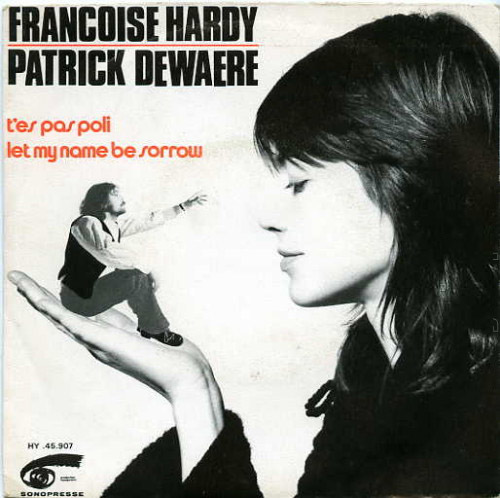
franpatrFrançoise H. knew ’em all, and among her countless duet partners also was Patrick Dewaere, probably the most gifted French actor of his generation – see Blier’s Les Valseuses, Corneau’s Série Noire, or certainly Granier-Deferre’s Adieu Poulet. Still a legend today, though virtually unknown outside of France, Dewaere called it quits on July 16, 1982, after a phone call from his wife Elsa who had run away to Guadeloupe with his best friend Coluche; the tragi-cynical dénouement being that Dewaere shot himself with a calibre .22 rifle that he had received as a gift from Coluche not long before. When Hardy heard of his suicide, she doubtless recalled the moment when she had seen Dewaere – a nobody then – perform a decade ago at the famous Café de la Gare, where she had also asked him if he had a song for her. In 1971, they recorded T’es pas poli (You’re Not Polite). It’s not a very good song, but a charming one, and among all those interchangeable daughter-in-law schlager ditties in Hardy’s œuvre a different, peculiarly private and precious moment.

Françoise Hardy/ Patrick Dewaere – T’es pas poli

Raphaël – Chanson pour Patrick Dewaere

Emilie Simon, Coeur de Pirate

We interrupt our Françoise Hardy week for two announcements. There’s a new Emilie Simon clip, for a song that’s surprisingly good:

And Coeur de Pirate’s coveralbum is out, featuring songs by Amy Winehouse, Bon Iver and Bill Withers. Songs she recorded for the Canadian tv-series Trauma. No French songs, alas. But this version of Wayne Cochran’s ‘Last Kiss‘ (best known for the cover version by Pearl Jam) is tres, tres jolie:

And there’s a video:

Françoise 70 (12): Live and how to end it

Mark Sullivan unearthed a whole bunch of fantastic clips and knowledge about Françoise Hardy’s career. Here is his guestpost on the last live show:

‘By 1968 Françoise Hardy had tired of the endless circuit of live concerts and fashion shoots. She always says that she was a nervous and private individual and that she did not like public appearances. ( (This has not kept her off the TV over the years since, as she enjoys talking on radio and television, with the occasional single song thrown in – the internet is not short of examples up to the present day.)

She told John Andrew in a BBC Radio 4 programme broadcast in 2011, why she gave up. ‘It was work. Things I had to do. A chore.’ (‘Une corvée’ she said in the radio programme) The ‘Daily Mail’ article that accompanied the programme is here.

Françoise was not in the public eye during the May 68 ‘évenements’ (which only lasted a month). The French popular artistes disappeared from view; the student rebels who occupied the universities sang and played the music of protest, which was in English, not the yé-yé songs of the commercial world created by Daniel Filipacchi and ‘Salut les Copains’. Joan Baez and Bob Dylan were their reference, not Françoise, Sylvie Vartan and Johnny Halliday. (The way in which another yé-yé star, Sheila, benefitted from ‘Soixante-huit’ is covered on another Filles Sourires page here)

Françoise decided to cease touring with an orchestra at the end of 1968. What looks to be her last live appearance in Britain, and perhaps anywhere in other than in performing single songs, was on British TV on New Year’s Eve, 31 December 1968.

It is explained by the poster (Erikavburen) in the comments of this YT-clip that the progamme included several famous British bands of the time. The audience can be seen in the flower-power fashions of 1968. In the midst of this stands Françoise, in a glittering long dress that is her nod to the era (she also wore a long dress in 1969 for ‘Comment te dire adieu‘). She sings three songs, À quoi ça sert’, ‘Où va la chance’ (‘There but for fortune’) and ‘Suzanne’ (an excellent translation of Leonard Cohen’s classic by Graeme Allwright).

The perfection, the reticence and the nervousness are all here; see her farewell at the end. As so often, she seemed to come from the future, a vision of what we will (or should) be, not what we are.’

Françoise 70 (11): To the End/La comedie

Continuing the guestposts to commemorate Françoise Hardy’s 70th birthday, this Friday. Here’s fellow Dutch journalist Norbert Pek on his favourite Hardy-duet:
‘A few French lines on a Blur album: in 1994 it was quite a thing. More remarkable even then Jamaicans entering the Olympics with a bobsled. Exaggeration, you say? Let me take you back to the 1991-tour after the release of Blur’s mediocre debut album Leisure. At one point the band members all ended up with a black eye. Not because of some angry Oasis-fans (they didn’t exist at that time), but the band members themselves fought with each other out of pure frustration: they had the skills, but they didn’t have the noteworthy sound. The album, the tour: it was a failure. Now what to do? Singer Damon Albarn said he had a plan and the rest should trust him. He wrote a bunch of songs that were very, very British. The other members complained loudly, but played along. The album ‘Modern Life Is Rubbish’ (1993) was concepated. The songs were about life in England. Together with the selftitled Suede-debut, Modern Life…. was the starting point of a huge Britpop-revival.
Blur then started to work on on the album that would become a mega-success: Parklife. The songs were again about ordinary Engelish people living their ordinary lives. The most British Britpop was Blur’s golden ticket to success, their unique selling point, but this album featured, all of a sudden, some French lines. Cor blimey!

But it doesn’t sound like eating escargots in a hamburger joint. The French part fits like a glove in ‘To The End’. Because, like every Parklife-song, it’s very refined and well-crafted. And Damon Albarn had a stroke of genius when he decided that the song didn’t need some extra love, it needed l’amour.

Francoise Hardy is not singing the song on Parklife. The band asked Laetitia Sadier from the indieband Stereolab for the French part. It isn’t exactly singing. It’s more like answering in a most sensual way, while Albarn does all the vocal work. In 1995 the song was re-recorded: Francoise Hardy agreed to a duet. The English blokes knew it wasn’t just a simple re-take, so some big changes had to be made.
The result is impressive. The string section was changed, now it’s more theatrical. The main difference is the shift in lyrics. Albarn drops some of his own lines and lets Hardy sing her own French version. Thank Dieu, it’s not a simple translation, but the big words about love also work in French. Of course they do. But Francoise Hardy gives every word in ‘To The End (La Comedie)’ depth en sensuality. That’s what happens when you ask a living legend.
So Francoise: cheers. Now up to 80. I know you can make it to the end. Vraiment.

Françoise 70 (10): Voila


Lord Knows Best by Dirty Beaches is the best song to use a sample of Françoise’s ‘Voila’ (boy does she look gorgeous in the video), I think. But did you know Robbie Williams and Sharleen Spiteri (of Texas) used it too?

Françoise 70 (9): At the movies

As St. Paul and Dear Eyes mentioned before, Françoise’s songs work very well in movies.
My own favourite is ‘L’Amitié’ in Les Invasions Barbares, a very touching movie about the last days of dying man that won an Academy Award in 2003. ‘L’Amitié’ is played over the last scenes and the end credits:

‘Tous les garçons’ is the chanson that is used the most in movies. See this incomplete list on IMDB. Metroland is probably the film in which the song fits best:

Very recent is the use of four Hardy songs in François Ozon’s ‘Jeune et Jolie‘. Ozon also used a Hardy-song in ‘8 Femmes’. One of the songs in ‘Jeune et Jolie’ is ‘Je suis moi’:

And, in addition to the Wes Anderson/Moonrise Kingdom clips shared earlier, Le temps de l’amour is used also in the 2013 documentary Ne Me Quitte Pas, about two Belgian friends:

Françoise 70 (8) : All Over The World

And Mark S. is at it again, with an informative exposé on Françoise’s Dans le monde entier/All over the world:

‘All over the World’ or ‘Dans le monde entier’ is one of the 20th century’s great songs, and perhaps the only one which is as effective in both English and French. Recorded by two great popular singers, Françoise Hardy and Judith Durham of the Seekers, it works as a romantic song, as calming background music (you hear it in airports and shopping centres the world over), and as a timeless arrangement.Françoise wrote the music and the French lyrics in 1965.
By then she was working with Charles Blackwell and his orchestra in London, and her best records of the 1960s in both French and English were recorded in England. The English lyric ‘All over the World’, along with some other English versions of Françoise’s songs, was written by Julian More (1928-2010), the Cambridge-educated lyricist and writer of book for 1950s musicals such as ‘Irma la Douce’ and ‘Expresso Bongo’. See an odd video of Hardy singing the English version in her pj’s here.

Allmusic’s Richie Unterberger writes about the song: “Like many of her songs, it’s a sad ballad, not so sad as to be soaked with self-pity or histrionics, but with a dignified melancholy. The chief instrumentation of “All Over the World” is an almost classical-style piano, played as if it’s a sonata after four sustained notes start the track. Hardy handles the rolling, wistful melody well, with the sense of sexy reserve that is typical of her vintage sides (…) Unlike some of the English versions Hardy did, “All Over the World” works because the lyrics retain a pungent universality, of people in love looking at the cosmos and wondering what other people in their predicament are doing, and what the people they love (but who aren’t there) are thinking and doing at the moment.”

The English-speaking world remembers that ‘All over the World’ was soon recorded by Judith Durham of the Seekers, the finest Australian popular singer of the 20th Century. Judith’s performance matches Françoise’s in quality and fully deserves the praise it has always received. The original recording is here. There is sadly no film of Françoise singing live either ‘Dans le monde entier’ or ‘All over the World’.
But we have Judith Durham’s memorable solo piano performance at the Royal Festival Hall, London in 2003.

There is an attractive version by Françoise in Italian, called ‘Nel mondo intero’ , which is accompanied by background film from the 1960s of Françoise talking and singing. This shows well how her looks and style, 50 years ago, seem 21st century, just as André Courrèges intended when he designed for her and set out to make her ‘the girl from the year 2000’.

Katie Melua has now covered ‘All over the World’, with solo guitar, as here in the RTL Studio in 2012.
The song’s simple perfection will surely attract others. It will be enjoyable to watch them attempt to match up to the peerless 1960s recordings by Françoise and Judith.
Françoise 70 (7): Le temps de l’amour

Another guestpost! St. Paul is one hell of a DJ, and a musical omivore. Just try one of his brilliant Perfect Kippevel (Perfect Goosebumps) compilations on Perfects.nl (this one, or this one). For this blog, he wrote a touching and highly personal post on his favourite Françoise-track:


“My girlfriend’s parents owned a second house in the south of France. They were a typical wine drinking, culturally engaged and fun loving family, while I was busy fighting off teenage angst listening to Nirvana. I lived alone with my mother and, because there was never enough money, I had never been on a holiday, not even within our own country.
So when I got a call from my girlfriend to come over to their house in France, an almost uncontrollable burst of excitement came over me. Armed with a carefully selected tape full of French songs and a rose for every day that we would be together I travelled a thousand miles to see her. As I reached the land of romance and finesse I found out that the love of my life had slept with the local guitar teacher.

I’m not a Francophile. What I still cherish though, are the songs. The songs from that tape. And the songs that i got to know in the years to come. My favorite Francoise Hardy tune would be Le Temps De L’Amour. For all the obvious reasons, such as the bouncy but delicate backbeat and of course the bittersweet vocals.
But it also works wonderfully in one of the greatest movies of all time. That classic dancing scene in Moonrise Kingdom only confirms the vivid qualities of the song. To me the scene feels more like an image track to the music than the other way around. It’s as director Wes Anderson tried to make the perfect music video, just like Spike Jonze recently did with Arcade Fire’s Afterlife.

Many of Hardy’s songs evoke an instant mental picture. They invade the heart as much as the mind. A lot of it has to do with the highly romantic delivery. As a DJ I consider myself to be a professional escapist, thus falling in love with your favorite female artists would be the easiest thing to do. Except it’s not. Take Beyoncé, she runs the world with her looks, songs and charm. But she remains too much of a star to feel closely connected to. With Francoise Hardy it’s different. When you see her walking down the street, rowing a boat or simply looking into the camera it’s as if she’s addressing you and only you. Like ‘messages personnels’, her songs have an immediate power. It’s like first love all over again. But this time everything’s alright.’

Quand le temps va et vient,
on ne pense a rien malgre ses blessures
.

Françoise 70 (5): Scarlatine cover

Scarlatine

Françoise Hardy turns 70 years old this week, this blog is marking that date firmly. Here’s a cover of a wonderful Hardy-song especially recorded for FillesSourires by the lovely Scarlatine (pictured) from Canada. You may remember Judith from a feature on FillesSourires (see here). She chose a track from Françoise’s first album from 1962, kept the waltzing tempo and added a choir plus some electronics. It’s modern with a retro tristesse feel.

Scarlatine – J’ai jeté mon coeur